Extended strategy collection
This collection covers Gunbot strategies that use focused combinations of trend, momentum, volatility, and price-structure signals. Some are designed for fast scalping, while others wait for broader trend or reversal setups. Every guide explains the strategy's trading logic, its user-facing settings, suitable market conditions, and the main risks to test before going live.
These strategies are starting points, not promises of profit. Begin in backtesting or with very small order sizes. Test the exact pair, exchange, candle period, and settings you intend to use: a configuration that behaves well in one market regime can behave very differently in another.
Pair notation used in these guides
Gunbot writes the spending currency first. USDT-BTC means the market where you spend USDT to buy BTC. To avoid ambiguous currency-role terminology, amount descriptions name the currency directly: entry limits, minimum order values, cash reserves, absolute spreads, and pip values are in USDT, while amounts retained from selling are in BTC.
Choosing where to start
Use the strategy's underlying idea as your first filter:
- Fast scalping: best explored on liquid pairs with tight spreads and frequent, orderly movement. Very short periods amplify fees, slippage, and candle noise.
- Trend-following: better suited to sustained directional markets. Sideways price action can produce repeated false starts.
- Channel and volatility setups: need enough movement for price to interact meaningfully with bands or channels. Quiet compression and violent breakouts require different settings.
- Reversal and confluence setups: wait for several conditions to agree. They usually trade less often, and permissive thresholds can weaken the reason for using confluence.
- Price-level and pattern setups: depend heavily on clean structure and reliable candle data. Test them across both ranging and trending samples.
Do not select a strategy by its name alone. Open its guide, read the market-fit and limitations sections, then adjust one group of settings at a time. Pay particular attention to order size, minimum gain, stop behavior, and any setting that changes whether the strategy waits for a fresh signal or accepts an existing state.
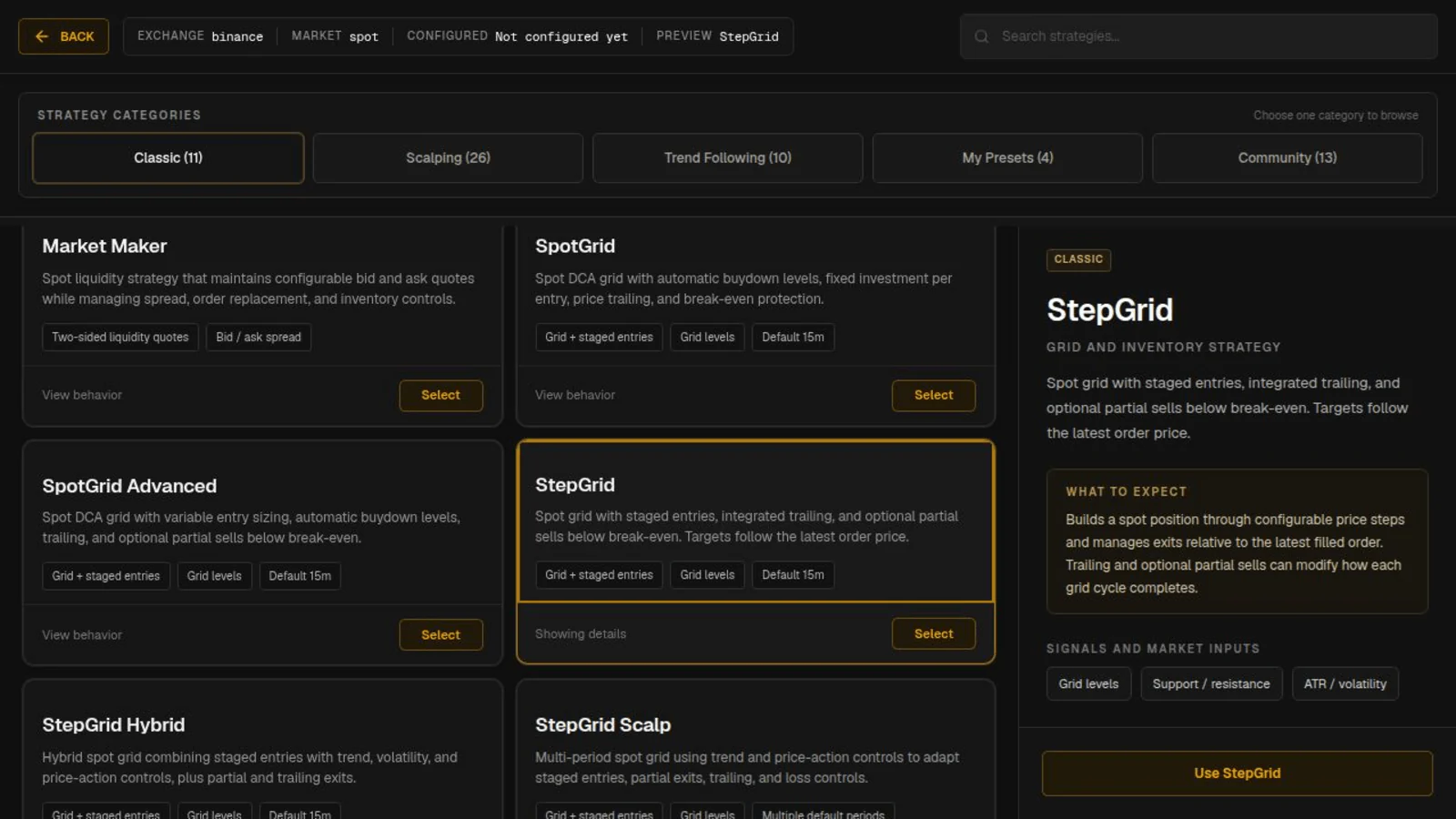 Use the strategy library to build a shortlist, then compare candidates by backtesting and simulation rather than by name.
Why the editor can show two trading limits
Most strategies in this collection expose a strategy-specific amount such as STBZ_TRADING_LIMIT alongside the generic TRADING_LIMIT.
For these strategies, the prefixed setting is the one to configure. The strategy reads TRADING_LIMIT only as a compatibility fallback when its own setting is missing or does not contain a positive value. Normal configurations already contain a positive strategy-specific default, so the generic value is ignored and the two settings do not need to match.
The requested amount can still be raised to the strategy's minimum order value when it would otherwise be too small for the configured market.
Strategy guides
Scalp and short-term systems
- EMA Predictive Scalp — combines predictive EMA behavior with short-term entry and exit controls.
- Neptune Scalp — uses a compact set of trend and momentum conditions for quick trades.
- Hybrid FX Scalp — combines several forex-style confirmations in a short-term system.
- Scalp Pattern — looks for a defined price pattern before entering.
- Anti Trading Scalp — applies its own filtered scalp conditions rather than following every small move.
- Extreme Scalp Modified — targets short-lived extremes with configurable confirmation.
- Action Trade Scalp — reacts to short-term price action and momentum conditions.
- 1 Min Scalper — a very short-period strategy where spread, fees, and execution quality are especially important.
- Simple Scalper — a relatively compact scalp setup with fewer interacting signal families.
- Super Scalping — uses multiple short-term checks to qualify rapid entries and exits.
- Pocket Rocket — looks for fast momentum opportunities with tightly scoped trade management.
Bands, channels, and volatility
- Bollinger RSI ADX Scalp — combines Bollinger Bands with RSI and ADX filters.
- Keltner EMA Scalp — uses Keltner Channel position together with EMA direction.
- EMA Bands Guppy Scalp — combines EMA bands with Guppy-style moving-average structure.
- Three Bollinger Scalp — evaluates several Bollinger Band configurations together.
- Keltner Scalp — builds its setup around price interaction with a Keltner Channel.
- EMA Band Scalp — uses a configurable EMA band as the central signal area.
- Supertrend Breakout Zone — combines Supertrend direction with a configurable breakout zone.
Trend and moving-average systems
- Double CCI RSIOMA — combines two CCI readings with RSIOMA confirmation.
- Levels GMMA Scalp — joins price levels with Guppy multiple-moving-average structure.
- SuperTrend EMA150 Scalp — filters Supertrend signals with a long-term EMA.
- PSAR Trend Scalper — uses Parabolic SAR in a short-term trend-following setup.
- 5 Minute Intraday — an intraday system intended for five-minute market structure.
- Forex Profit System — follows a three-EMA structure confirmed by Parabolic SAR.
- Cross EMA Trading System — trades configurable EMA cross behavior.
- Simple MACD and EMA — combines MACD momentum with an EMA trend filter.
- Simple Moving Average and MACD — pairs a simple moving-average view with MACD confirmation.
- 5 Minute EMA Intraday — focuses on EMA-based intraday setups on a five-minute period.
Reversal, momentum, and confluence systems
- PSAR Fibonacci Scalp — combines Parabolic SAR direction with Fibonacci-derived levels.
- PSAR CCI Scalp — confirms Parabolic SAR conditions with CCI momentum.
- Williams Trade Modified — adapts a Williams-style momentum setup with configurable trade management.
- QFL 3C Scalper — finds confirmed bases, waits for a crack below them, and manages staged recovery trades.
- Tom Demark FX System — uses a Tom Demark-inspired sequence of price conditions.
- CI System — combines its indicator conditions into a filtered entry and exit system.
- Brahmos Confluence — requires agreement across several signal families.
- CCI Stochastic GMMA — combines CCI, Stochastic, and Guppy moving-average confirmation.
A practical testing routine
Backtest enough history to include trends, ranges, sharp sell-offs, and quiet periods. Then check more than the final return:
- Inspect individual entries and exits to confirm they match the setup described in the guide.
- Compare trade frequency, drawdown, average gain, and the effect of fees.
- Change one setting group at a time so you can tell what caused the result.
- Re-test on a different time window and on unseen data.
- Forward-test without live orders, or with minimal size, before increasing exposure.
The individual guides explain which settings control signal strictness and which settings control trade management. Keep those two jobs separate while tuning: first make sure the strategy enters in the market situations you want, then decide how it should manage those trades.