PSAR CCI Scalp
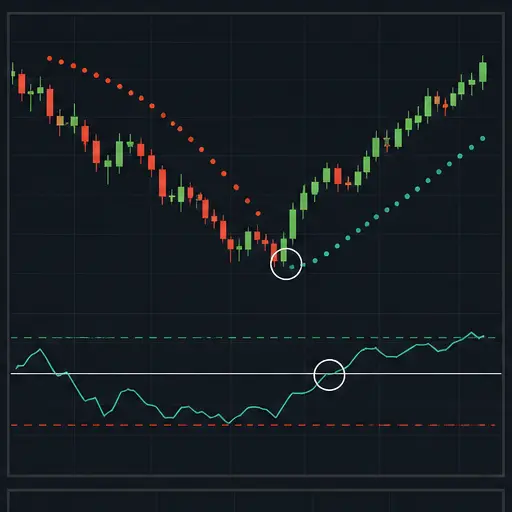
PSAR CCI Scalp combines Parabolic SAR, a simple moving average, and Commodity Channel Index (CCI). It looks for strong positive momentum while the Parabolic SAR value sits above the SMA. Optional confirmation can require the PSAR trend itself to be bullish and CCI to make a fresh threshold cross.
Unlike a simple fixed-target strategy, PSAR CCI Scalp derives its target from the distance to a structural stop around Parabolic SAR. A configurable risk/reward ratio and minimum target determine how much upside the setup must seek.
This method is best suited to liquid markets developing a clear bullish impulse. It is less suitable for sideways markets where PSAR flips frequently and CCI repeatedly crosses extreme levels.
warning
The protective stop is disabled by default. The calculated stop distance still shapes the profit target even when stop execution is disabled.
Entry setup
A long entry always requires:
- the current Parabolic SAR value above the configured SMA;
- CCI above
PCS_CCI_BUY_LEVEL; - a bullish PSAR trend when
PCS_REQUIRE_PSAR_TRENDis enabled.
With the PSAR trend requirement enabled, a bullish SAR value sits below price. Because that SAR value must also be above the SMA, price is effectively above both references.
If you disable PCS_REQUIRE_PSAR_TREND, only the numeric relationship between PSAR and SMA remains. A bearish PSAR value above price can then satisfy that part of the long setup. This materially loosens the strategy and should be tested carefully.
CCI state or fresh cross
When PCS_REQUIRE_CCI_CROSS is enabled, CCI must cross from at or below the buy level to above it on the current candle.
When disabled, any current CCI reading above the buy level qualifies. This can enter during an ongoing momentum phase instead of only at the threshold transition.
The mirrored bearish setup uses PCS_CCI_SELL_LEVEL, PSAR below the SMA, and—when required—a bearish PSAR trend.
The strategy opens one position at a time and does not average down.
Parabolic SAR and SMA
PCS_PSAR_STEP controls how quickly Parabolic SAR accelerates toward price. PCS_PSAR_MAX limits that acceleration and must remain at or above the step.
Faster PSAR settings react sooner but flip more often during ranges. Slower settings give a trend more room at the cost of later confirmation and potentially wider structural risk.
PCS_SMA_LENGTH controls the trend reference used in the PSAR-versus-SMA comparison. Increasing it produces a slower structural filter; decreasing it makes the relationship change more frequently.
Risk-derived target
At entry, the strategy first estimates a stop below Parabolic SAR:
- in pip mode, the buffer is
PCS_STOP_BUFFER_PIPS × PCS_PIP_SIZE; - in percentage mode,
PCS_STOP_PCTdetermines the buffer.
If a valid PSAR stop cannot be placed below the entry, the same pip or percentage distance is used below the entry as a fallback.
The entry-to-stop distance becomes the trade’s risk distance. PCS_RISK_REWARD_RATIO multiplies that risk to produce the initial target.
The strategy also enforces a minimum target:
PCS_MIN_TARGET_PIPSin pip mode;PCS_MIN_TARGET_PCTin percentage mode.
If the minimum target is larger than the risk-derived target, the effective risk distance and stored stop are widened so the requested ratio remains represented. Estimated fees and PCS_MIN_NET_GAIN_PCT can raise the final target further.
For example, a risk/reward ratio of 0.8 asks for 0.8 units of reward per unit of calculated risk. This produces a target closer than the stop distance unless the minimum target or fee floor changes it.
Exits
The target exit remains active regardless of whether protection is enabled.
Enable PCS_USE_PROTECTION to allow the calculated stop to close a losing position. Without it, the stop still determines target geometry but is not executed.
Three technical exits can close only at the fee-aware profitable level:
PCS_EXIT_ON_SHORT_SIGNALexits on the complete mirrored bearish setup.PCS_EXIT_ON_CCI_FLIPexits when CCI reaches zero or below. It does not wait for the configured sell level.PCS_EXIT_ON_PSAR_FLIPexits when the Parabolic SAR value moves below the SMA. Despite the label, this condition is the PSAR/SMA relationship and does not require a fresh PSAR trend flip on that candle.
These exits cannot deliberately close an underwater position.
Good market conditions
PSAR CCI Scalp generally works best when:
- the market is liquid and spreads are small;
- price and bullish PSAR are clearly above the SMA;
- CCI moves decisively through the positive threshold;
- the PSAR-derived stop is not excessively far from entry;
- available volatility supports the risk-derived and fee-aware target.
A healthy setup often occurs as a developing uptrend accelerates: PSAR remains beneath price but above the SMA, while CCI crosses into strong positive territory.
Avoid choppy ranges with alternating PSAR direction and repeated CCI threshold crosses. Also inspect setups where PSAR is far below entry: their derived risk can produce a target or loss size unlike an ordinary scalp.
Creating the strategy
Create a spot strategy and choose PSAR CCI Scalp as the buy and sell method. Start with backtesting or paper trading.
A practical setup order is:
- Select a liquid pair and realistic candle period.
- Keep the default SMA, CCI, and PSAR settings initially.
- Compare fresh CCI crosses with persistent above-threshold states.
- Keep PSAR trend confirmation enabled for the first tests.
- Review the calculated stop and target distances together.
- Set pip size and spread limits for the selected pair.
- Decide whether the calculated stop should actually be enabled.
- Test ranges, false breakouts, and sustained trends.
Strategy settings
Trading and execution
| Setting | Description |
|---|---|
BUY_ENABLED | Enables new buy orders. |
SELL_ENABLED | Enables target, technical, and protective sell orders. |
PERIOD | Candle period used for SMA, CCI, and PSAR calculations. |
TRADING_LIMIT | Compatibility fallback only. It is ignored while the strategy-specific trading limit contains a positive value. Configure the strategy-specific setting for normal use. For USDT-BTC, this value is in USDT. |
PCS_TRADING_LIMIT | For USDT-BTC, the amount of USDT used for an entry. |
FUNDS_RESERVE | For USDT-BTC, the amount of USDT the bot must leave unused. |
KEEP_QUOTE | For USDT-BTC, the amount of BTC the strategy must not sell. |
MIN_VOLUME_TO_BUY | General minimum buy value. For USDT-BTC, this value is in USDT. |
MIN_VOLUME_TO_SELL | General minimum sell value. For USDT-BTC, this value is in USDT. |
PCS_MIN_ORDER_VALUE | Strategy-specific minimum entry value. For USDT-BTC, this value is in USDT. |
PCS_MIN_SELL_VALUE | Strategy-specific minimum exit value. For USDT-BTC, this value is in USDT. |
PCS_COOLDOWN_MS | Minimum delay in milliseconds between actions. |
PCS_ENFORCE_COOLDOWN_IN_BACKTEST | Applies the cooldown during backtests as well as live trading. |
PCS_MAX_SPREAD_PCT | Maximum permitted bid/ask spread as a percentage. |
PCS_MAX_SPREAD_ABSOLUTE | Optional maximum spread in USDT for a pair such as USDT-BTC. Set 0 to disable it. |
PCS_NEWS_BLOCK | Manually blocks new entries while existing positions remain manageable. |
PCS_NEWS_BLOCK_UNTIL | Blocks entries until the configured time. |
Signal settings
| Setting | Description |
|---|---|
PCS_SMA_LENGTH | Length of the SMA used for the PSAR relationship. |
PCS_CCI_LENGTH | CCI lookback. Shorter values react faster and fluctuate more. |
PCS_CCI_BUY_LEVEL | Positive CCI threshold for long entries. |
PCS_CCI_SELL_LEVEL | Negative CCI threshold for mirrored bearish signals. |
PCS_PSAR_STEP | Parabolic SAR acceleration step. |
PCS_PSAR_MAX | Maximum Parabolic SAR acceleration; keep it at or above the step. |
PCS_REQUIRE_CCI_CROSS | Requires a fresh threshold crossing instead of an ongoing above- or below-threshold state. |
PCS_REQUIRE_PSAR_TREND | Requires bullish PSAR direction for longs and bearish direction for mirrored short signals. |
Target and protection
| Setting | Description |
|---|---|
GAIN | General gain fallback used by the minimum percentage target when needed. |
PCS_USE_PIPS | Uses pip-based stop buffers and minimum targets instead of percentage values. |
PCS_PIP_SIZE | For USDT-BTC, the USDT value represented by one pip. |
PCS_STOP_BUFFER_PIPS | Distance below Parabolic SAR in pip mode. |
PCS_STOP_PCT | Percentage stop buffer and fallback in percentage mode. |
PCS_USE_PROTECTION | Activates the calculated protective stop. The stop still shapes the target when disabled. |
PCS_RISK_REWARD_RATIO | Reward distance requested per unit of calculated stop risk. |
PCS_MIN_TARGET_PIPS | Minimum target distance in pip mode. |
PCS_MIN_TARGET_PCT | Minimum target distance in percentage mode. |
PCS_MIN_NET_GAIN_PCT | Minimum intended gain beyond estimated round-trip fee break-even. |
Technical exits
| Setting | Description |
|---|---|
PCS_EXIT_ON_SHORT_SIGNAL | Enables a profitable exit on the complete mirrored bearish setup. |
PCS_EXIT_ON_CCI_FLIP | Enables a profitable exit when CCI reaches zero or below. |
PCS_EXIT_ON_PSAR_FLIP | Enables a profitable exit when the PSAR value moves below the SMA. |
Backtesting range
| Setting | Description |
|---|---|
BF_SINCE | Start of the selected backtesting period. |
BF_UNTIL | End of the selected backtesting period. |
DEEP_TESTING | Enables deeper backtesting mode in the editor. |
Practical tuning directions
For selective momentum transitions, keep both CCI cross and PSAR trend confirmation enabled. For more persistent trend entries, disable the CCI cross requirement while retaining PSAR direction.
Use the risk/reward ratio only after inspecting actual PSAR stop distances. A ratio cannot make an unusually wide structural stop low-risk; it only determines the corresponding target geometry.
Increasing the minimum target may also widen the stored stop to preserve the ratio. Test minimum target, ratio, and protection together rather than adjusting them independently.
If losing positions remain open after indicators weaken, technical exits will not solve the issue below break-even. Enable and test PCS_USE_PROTECTION if a defined loss exit is required.
Important limitations
- CCI can stay beyond an extreme threshold during strong moves.
- PSAR can flip repeatedly in sideways markets.
- Disabling PSAR trend confirmation materially loosens the long setup.
- The theoretical stop shapes the target even when protection is disabled.
- Minimum-target settings can widen the calculated risk distance.
- Technical exits do not deliberately realize a loss.
- The PSAR/SMA exit is not necessarily a fresh PSAR direction flip.
- Backtests cannot perfectly reproduce live spread, slippage, latency, or liquidity.
PSAR CCI Scalp is most useful when a strong CCI move appears inside a clearly structured bullish PSAR/SMA relationship. Its risk-derived target makes inspecting the geometry of each setup just as important as counting entries.