Super Scalping
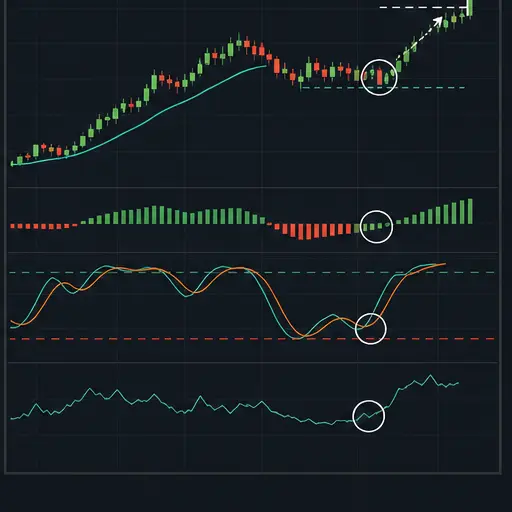
Super Scalping combines an ATR-based directional arrow with optional EMA and RSI confirmation. It can trade only fresh direction changes or accept an ongoing directional state. Targets may use recent pivot resistance, while the protective stop can reference a fixed distance, recent swing low, direction line, or pivot support.
The default long setup requires a fresh bullish arrow, fast EMA above slow EMA, and RSI at or above its buy level.
This strategy is best suited to liquid markets where a volatility-adjusted direction change is supported by trend and momentum. It is less suitable for ranges that produce repeated arrow flips.
warning
Protection is disabled by default. Technical exits are break-even protected. Also review the filter-flip exit carefully before disabling either entry filter; their settings interact.
Direction arrow
The arrow is derived from an ATR-based trend line:
SSP_ARROW_ATR_LENGTHsets the volatility lookback;SSP_ARROW_ATR_MULTcontrols the line’s distance from price.
Lower or faster values create earlier, more frequent changes. Higher values give price more room and make the direction state slower.
With SSP_REQUIRE_ARROW_FLIP enabled, a buy requires the first candle that changes into an upward direction. When disabled, any candle in an ongoing upward direction can qualify.
The mirrored sell arrow uses the corresponding downward state or fresh flip.
Optional entry filters
EMA filter
When SSP_REQUIRE_EMA_FILTER is enabled, a buy additionally requires SSP_FAST_EMA above SSP_SLOW_EMA. Keep the slow length greater than the fast length.
RSI filter
When SSP_REQUIRE_RSI_FILTER is enabled, RSI must be at or above SSP_RSI_BUY_LEVEL. Mirrored sell signals require RSI at or below SSP_RSI_SELL_LEVEL.
Keep a neutral gap between buy and sell levels to avoid both sides changing too easily.
The strategy holds one position at a time and does not average down.
Target selection
SSP_PIVOT_LOOKBACK defines a recent high, low, and previous close used to calculate R1/R2 resistance and S1/S2 support.
When SSP_USE_PIVOT_TARGET is enabled in pip mode, the strategy chooses the nearest R1 or R2 lying between SSP_TARGET_PIPS_MIN and SSP_TARGET_PIPS_MAX above entry. If no pivot fits, it uses SSP_TARGET_PIPS.
In percentage mode, the pivot window collapses to the fixed percentage distance, so the strategy normally uses SSP_TARGET_PCT. Use pip mode when pivot-target selection matters.
Estimated round-trip fees and SSP_MIN_NET_GAIN_PCT can raise the final target.
Protective stop
The strategy compares valid stop references below entry:
- the fixed pip or percentage distance;
- the lowest low in
SSP_SWING_LOOKBACK; - the ATR arrow line;
- S1 and S2 when
SSP_USE_PIVOT_STOPis enabled.
The closest valid level becomes the planned stop. Enable SSP_USE_PROTECTION to activate it.
The recent swing high is displayed as context, but the long protective stop uses the swing low.
Technical exits
SSP_EXIT_ON_NEXT_ARROW exits on the complete mirrored sell setup: a down arrow plus any enabled bearish EMA and RSI confirmations. It requires a fee-aware profitable price.
SSP_EXIT_ON_FILTER_FLIP exits when either the EMA sell condition or RSI sell condition is satisfied, also only at a profitable price.
There is an important interaction: a disabled filter is treated as automatically satisfied. Therefore:
- if
SSP_REQUIRE_EMA_FILTERis disabled, the EMA side of the filter-flip exit is always satisfied; - if
SSP_REQUIRE_RSI_FILTERis disabled, the RSI side is always satisfied.
Because the exit accepts either side, disabling either filter while leaving SSP_EXIT_ON_FILTER_FLIP enabled makes the exit eligible whenever the position reaches the fee-aware profitable level. If you intentionally disable an entry filter, consider disabling the filter-flip exit as well.
Good market conditions
Super Scalping generally works best when:
- spread is small and liquidity is reliable;
- the ATR arrow changes into a sustained bullish state;
- fast EMA is above slow EMA;
- RSI confirms positive momentum without being the only bullish evidence;
- a pivot or fixed target leaves room after fees;
- recent swing and direction references provide a sensible stop.
A good setup often follows consolidation or a pullback and then produces a fresh arrow with aligned EMA and RSI.
Avoid markets where arrows alternate frequently, EMAs are intertwined, or RSI repeatedly crosses the neutral gap. Also be cautious when a pivot target is so close that the fee-aware minimum must override it.
Creating the strategy
Create a spot strategy and choose Super Scalping as the buy and sell method. The default period is five minutes. Start with backtesting or paper trading.
A practical setup process is:
- Select a liquid pair and verify pip size.
- Keep fresh arrows and both filters enabled initially.
- Tune ATR direction before changing EMA and RSI together.
- Use pip mode when evaluating pivot targets.
- Inspect which structural reference selects the stop.
- If disabling an entry filter, review the filter-flip exit at the same time.
- Set every spread limit deliberately.
- Test ranging, false-breakout, and sustained-trend samples.
Strategy settings
Trading and execution
| Setting | Description |
|---|---|
BUY_ENABLED | Enables new buy orders. |
SELL_ENABLED | Enables target, technical, and protective sell orders. |
PERIOD | Candle period used for all calculations; the default is five minutes. |
TRADING_LIMIT | Compatibility fallback only. It is ignored while the strategy-specific trading limit contains a positive value. Configure the strategy-specific setting for normal use. For USDT-BTC, this value is in USDT. |
SSP_TRADING_LIMIT | For USDT-BTC, the amount of USDT used for an entry. |
FUNDS_RESERVE | For USDT-BTC, the amount of USDT the bot must leave unused. |
KEEP_QUOTE | For USDT-BTC, the amount of BTC the strategy must not sell. |
MIN_VOLUME_TO_BUY | General minimum buy value. For USDT-BTC, this value is in USDT. |
MIN_VOLUME_TO_SELL | General minimum sell value. For USDT-BTC, this value is in USDT. |
SSP_MIN_ORDER_VALUE | Strategy-specific minimum entry value. For USDT-BTC, this value is in USDT. |
SSP_MIN_SELL_VALUE | Strategy-specific minimum exit value. For USDT-BTC, this value is in USDT. |
SSP_COOLDOWN_MS | Minimum delay in milliseconds between actions. |
SSP_ENFORCE_COOLDOWN_IN_BACKTEST | Applies the cooldown during backtests as well as live trading. |
SSP_MAX_SPREAD_PCT | Maximum permitted spread as a percentage. |
SSP_MAX_SPREAD_ABSOLUTE | Optional maximum spread in USDT for a pair such as USDT-BTC. 0 disables it. |
SSP_MAX_SPREAD_PIPS | Optional maximum spread in pips. 0 disables it. |
SSP_NEWS_BLOCK | Manually blocks new entries while existing positions remain manageable. |
SSP_NEWS_BLOCK_UNTIL | Blocks entries until the configured time. |
Direction and filters
| Setting | Description |
|---|---|
SSP_ARROW_ATR_LENGTH | ATR lookback for the directional arrow. |
SSP_ARROW_ATR_MULT | Volatility multiplier controlling the direction boundary. |
SSP_REQUIRE_ARROW_FLIP | Requires a fresh change into the relevant direction. |
SSP_FAST_EMA | Fast EMA length. |
SSP_SLOW_EMA | Slow EMA length; keep it above the fast length. |
SSP_RSI_LENGTH | RSI lookback. |
SSP_RSI_BUY_LEVEL | Minimum RSI for a filtered long entry. |
SSP_RSI_SELL_LEVEL | Maximum RSI for a filtered mirrored sell signal. |
SSP_REQUIRE_EMA_FILTER | Requires bullish or bearish EMA order for the respective signal. |
SSP_REQUIRE_RSI_FILTER | Requires RSI beyond the corresponding buy or sell level. |
Swing and pivot structure
| Setting | Description |
|---|---|
SSP_SWING_LOOKBACK | Recent candles used to find the swing low for a long stop reference. |
SSP_PIVOT_LOOKBACK | Recent candles used to calculate pivot support and resistance. |
SSP_USE_PIVOT_TARGET | Uses a qualifying R1/R2 target in pip mode. |
SSP_USE_PIVOT_STOP | Includes S1/S2 among protective stop candidates. |
Target and protection
| Setting | Description |
|---|---|
GAIN | General gain fallback retained in the configuration. |
SSP_USE_PIPS | Uses pip target/stop distances and the practical pivot-target window. |
SSP_PIP_SIZE | Value of one pip. 0 selects 0.01 for JPY pairs and 0.0001 otherwise. For USDT-BTC, this value is in USDT. |
SSP_TARGET_PIPS | Requested fixed target in pip mode. |
SSP_TARGET_PIPS_MIN | Minimum pip target and lower pivot-target boundary. |
SSP_TARGET_PIPS_MAX | Maximum pip target and upper pivot-target boundary. |
SSP_STOP_PIPS | Fixed protective distance in pip mode. |
SSP_TARGET_PCT | Fixed target percentage when pip mode is disabled. |
SSP_STOP_PCT | Fixed stop distance in percentage mode. |
SSP_MIN_NET_GAIN_PCT | Minimum intended gain beyond estimated round-trip fee break-even. |
SSP_USE_PROTECTION | Activates the closest selected stop reference. |
Technical exits
| Setting | Description |
|---|---|
SSP_EXIT_ON_NEXT_ARROW | Enables a profitable exit on the full mirrored arrow/filter sell setup. |
SSP_EXIT_ON_FILTER_FLIP | Enables a profitable exit when either bearish filter condition is satisfied. Disable it when disabling either entry filter unless that immediate eligibility is intentional. |
Backtesting range
| Setting | Description |
|---|---|
BF_SINCE | Start of the selected backtesting period. |
BF_UNTIL | End of the selected backtesting period. |
DEEP_TESTING | Enables deeper backtesting mode in the editor. |
Practical tuning directions
For selective emerging trends, keep fresh-arrow, EMA, and RSI requirements enabled. For continuation entries, disable the arrow-flip requirement while retaining the filters.
Increase the ATR multiplier for fewer direction changes or reduce it for quicker signals. Change one component at a time so you can distinguish arrow timing from filter selectivity.
Use pip mode to test pivot targets meaningfully. Check that the min/max window includes realistic resistance distances.
If you remove either entry filter, either disable the filter-flip exit or explicitly test its resulting profit-level behavior.
Important limitations
- ATR arrows can whipsaw in ranges.
- EMA and RSI confirmation introduce delay.
- Pivot targets are practically selected only in pip mode.
- The filter-flip exit becomes automatically eligible at a profitable price when either filter is disabled.
- Technical exits do not deliberately realize a loss.
- Swing and pivot levels are recent references, not guaranteed support.
- Backtests cannot perfectly reproduce live spread, slippage, latency, or liquidity.
Super Scalping works best when the arrow and filters provide independent confirmation. Treating disabled filters as harmless can materially change exits, so configure entry and exit switches as one coherent system.