
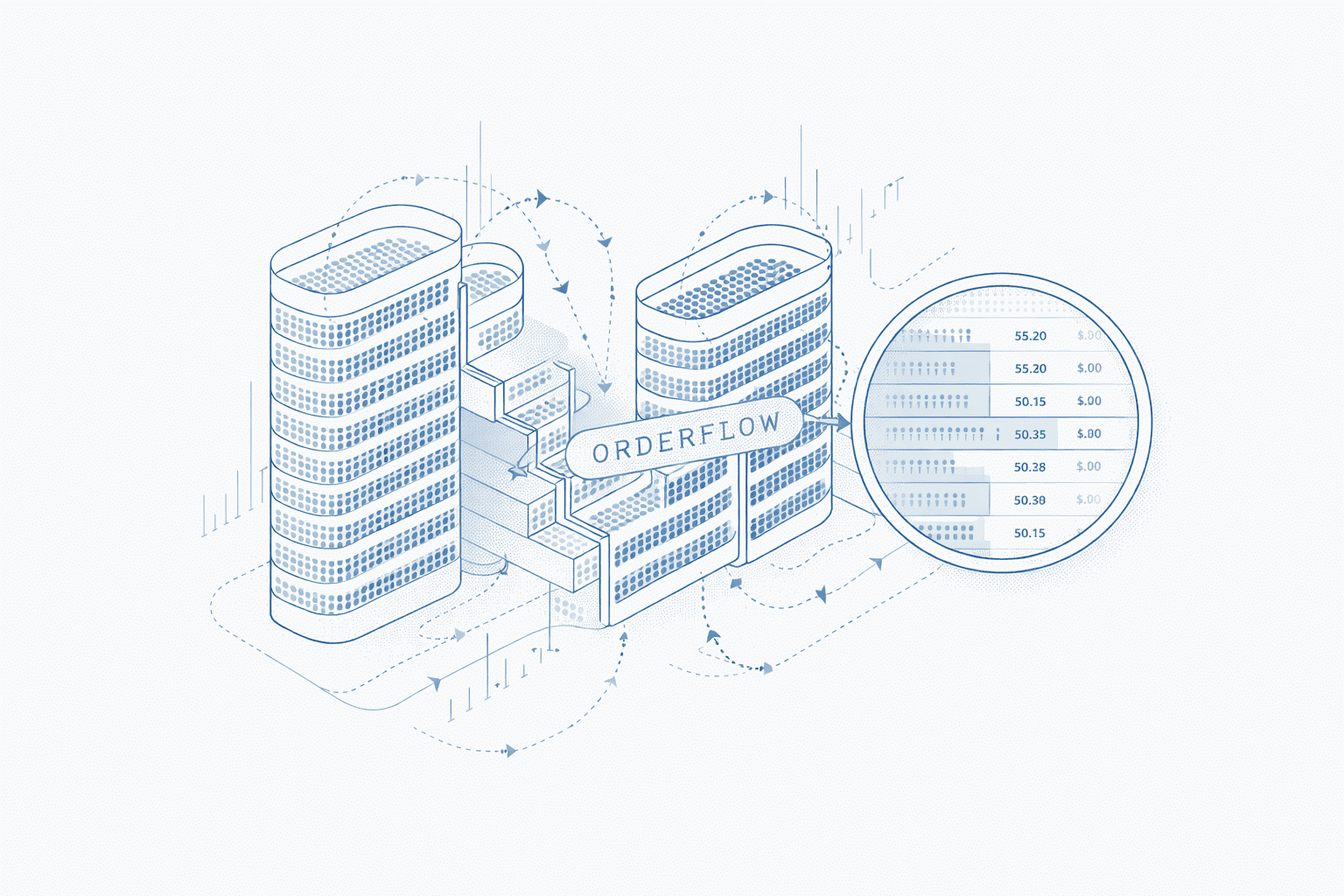
Most trading bots are chart readers. They wait for a candle to close, check a few indicators, and decide what to do based on something that already happened. Wick Magic's orderflow engine works differently — it reads the live order book and the real trade tape, and enters based on what the market is doing right now.
Two Engines, One Strategy
Wick Magic ships as two things. The first is a standard TA branch: Heikin Ashi candles, RSI, volume signals, breakout detection. Works on most pairs, easier to configure, good starting point if you just want something running.
The second is the OrderFlow engine, which is the more involved one and probably the reason you're reading this.
The orderflow side doesn't wait for candles. It reads two live data sources continuously: the order book (every pending buy and sell sitting on the exchange right now) and the Public Trade History, which is every order that actually executed in the last 90 seconds. From these it calculates an imbalance score from -1 to +1 representing current buying or selling pressure.
Both signals have to agree before anything happens. Order book showing strong buyer pressure and the tape confirming that buyers are the aggressive ones, actually initiating trades? Entry. Book looks bullish but the tape shows sellers driving things? The signals conflict and the bot skips it. The practical upside is that you're working off what the market is doing now rather than what it did a few candles ago.
Thresholds That Adjust Themselves
One problem most orderflow bots don't bother solving: a fixed threshold doesn't hold up across pairs and conditions. "Buy when imbalance is above 0.35" sounds reasonable until you realise that 0.35 on BTC during London open is a completely different signal than 0.35 on an altcoin at 3 AM.
Wick Magic runs a genetic algorithm in the background that handles this. It takes the last ~1000 candles of real data on a sliding window, generates around 60 candidate threshold pairs, breeds the best performers across 220 generations, and lands on whichever combination best predicted candle direction over that sample. The GA trains purely on combined imbalance versus actual candle direction — ATR only comes in as a regime-change detector, triggering early recalibration if volatility shifts enough between the regular four-hour cycles.
In practice this means USDT-ETH might calibrate to a buy threshold of 0.52 while USDT-BTC lands at 0.38. Same bot, different markets, different numbers, worked out automatically.
On a fresh deployment the bot won't enter any orderflow trades until it's collected 200 candles to calibrate against, which is roughly 15 hours on 5-minute candles. Restarts don't reset anything — samples, thresholds, and timers all persist to disk so it picks up exactly where it left off. Re-buys on existing positions are never blocked by warmup, only fresh entries on pairs without a bag.
Buying Near Levels That Matter
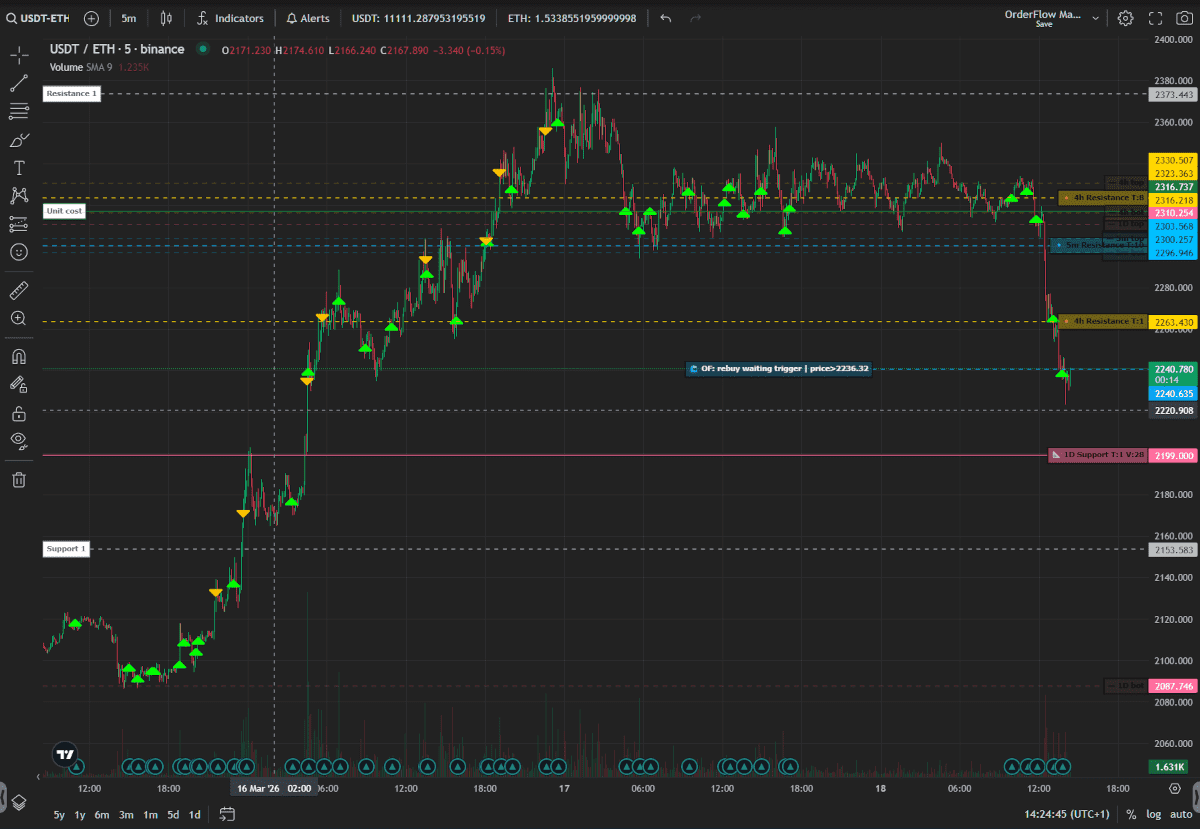
Even a clean orderflow signal is a lower-confidence trade if price is floating in the middle of nowhere. Wick Magic addresses this with a multi-timeframe S/R confluence engine that automatically identifies key price levels across three timeframes and looks for areas where they agree.
A 5m pivot at 2260 and a 4h pivot at 2263 sitting within 1% of each other merge into one confirmed zone. When S/R is enabled, orderflow entries are only allowed when price is within a configurable proximity of one of those zones. The practical effect is that signals which would otherwise fire randomly in open space get filtered out, and entries end up anchored to levels the market has actually respected before.
Trap Detection and Absorption
Markets fake moves. A bull trap pushes price up sharply then reverses. A bear trap dumps hard then bounces. Wick Magic cross-checks the order book shape against the trade tape to catch when a move looks suspicious, and blocks the entry or re-buy if a trap pattern is detected.
On the absorption side: when large players are defending a price level they absorb incoming sell pressure without letting price fall. High sell volume on tape, price barely moving, strong bid side holding. The strategy detects this pattern and treats it as extra confirmation, so a bearish tape signal alone isn't enough to block entry if the data suggests institutions are soaking up the selling.
Sentiment Scaling and Session Awareness
Two features that do quiet but useful work. FGI Mimix Scaling adjusts position size based on the Fear & Greed Index, putting more in during fear periods and pulling back during greed. Most traders intend to do this and don't follow through, so having it run automatically removes that temptation.
Institution Hours recognises that while crypto trades 24/7, the order flow that makes book signals reliable concentrates between the London and New York sessions, roughly 7 AM to 9 PM UTC. Outside those hours you can either block new entries entirely or run in scout mode, which raises the conviction bar: the buy threshold goes up 40%, tape requirements tighten, and above-average volume is required before anything fires. Sells and partial exits are never affected regardless of which mode you're in.
There's also Compound Profits, which adjusts your trade size based on cumulative realised PnL across completed cycles. After a run of winning trades the next entries are slightly larger, after a losing one they shrink back. There's a floor at 25% of base size so it can't spiral, and the offset persists across restarts.
The TA Branch Isn't Just Filler
The classic side holds up on its own. DCA requires trend confirmation, has cooldown timers between entries, and includes a freeze zone that stops new purchases if price keeps dropping past a set level. That last part is more important than it sounds — unconstrained averaging into a falling market is how accounts quietly disappear.
You can also run both engines together: classic TA for entries with the orderflow gate handling partial exits. It's a reasonable way to test the exit engine before committing to full orderflow mode.
Before You Buy
A Gunbot DeFi license is a prerequisite on top of the strategy cost, so factor that in. The orderflow engine works best on BTC, ETH, and SOL because those books are deep enough for the tape signal to carry real information. On thinner pairs it gets unreliable.
Configuration depth is real — genetic algorithm parameters, S/R zone sizing, iceberg detection, session gating, and more. The strategy ships with two presets though, one for fast 5m scalping and one for higher-conviction 15m entries during active sessions, and for most people those are a sensible place to start and probably fine to stay close to until you have enough context to know what you'd want to change.
Lifetime license is €275. Docs are thorough, logic is explained properly, and there's a Telegram community if you get stuck. If you're running Gunbot on liquid pairs and want to move beyond lagging indicators, this is built for that. You can get Wick Magic here